Electric toothbrush vs manual: worth an extra $51 to $57 a year?
What the evidence says
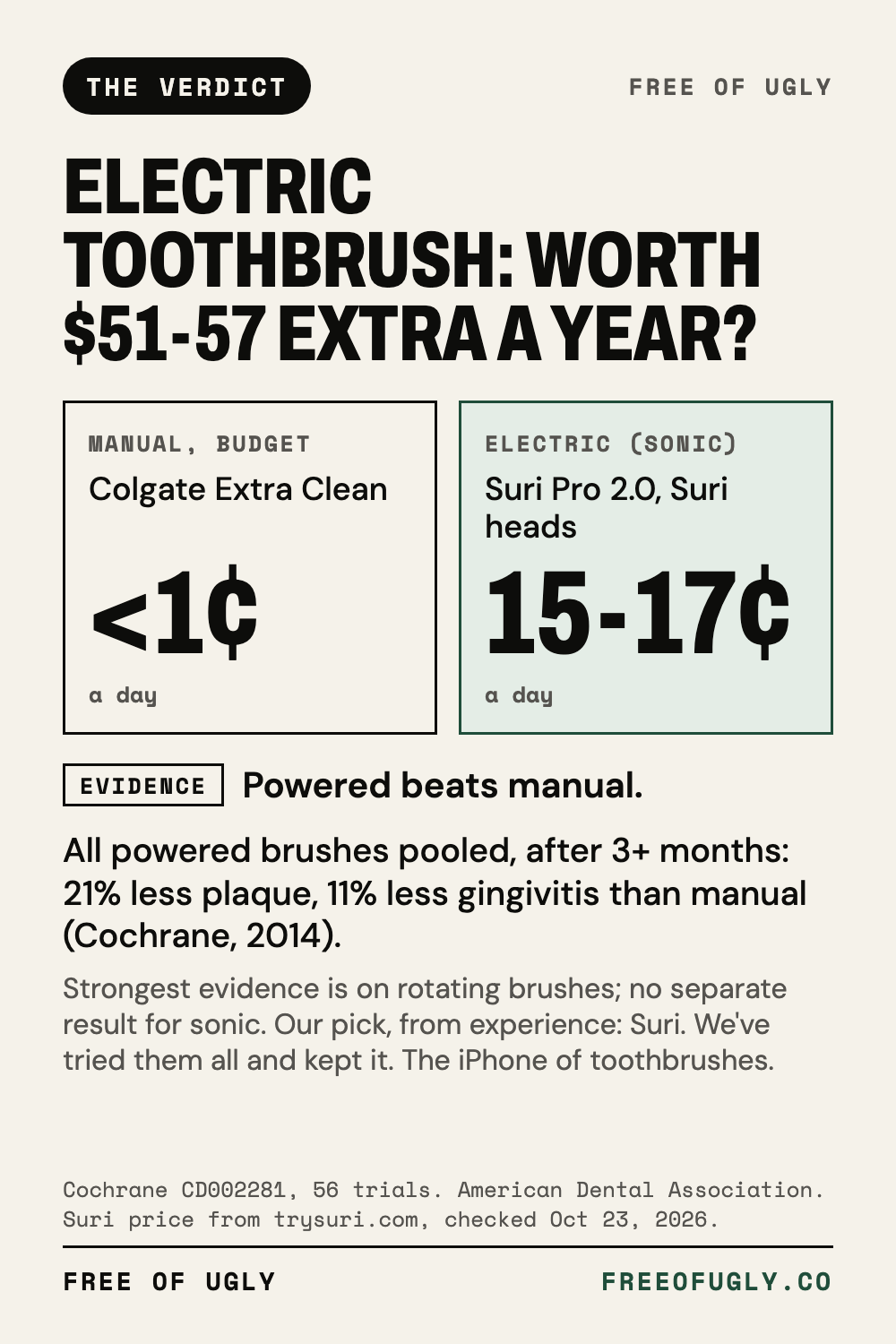
The Cochrane review of powered versus manual brushing included 56 trials; 51 trials with 4,624 people provided data. Compared with manual brushing, powered brushes as a group reduced plaque by about 11% at 1 to 3 months and about 21% after 3 months. Gingivitis (gum inflammation) fell by about 6% and about 11%. The review rates the evidence as moderate quality.
The same review says plainly that "the clinical importance of these findings remains unclear." The American Dental Association says both types of toothbrush can clean teeth effectively and thoroughly. So the honest framing is a measurable but modest edge.
By brush type, the review's abstract says: "The greatest body of evidence was for rotation oscillation brushes which demonstrated a statistically significant reduction in plaque and gingivitis at both time points." It lists 27 trials of rotating brushes and 10 of side-to-side brushes, but reports no separate result for side-to-side brushes. Whether sonic designs fall in that group is not stated in the abstract. So the pooled result for all powered brushes is positive, and the clearest by-type result is for rotating brushes. We cannot say from the review that sonic brushes like Suri match them.
Our pick: Suri
This part is experience, not evidence. We've tried them all and replaced them three or four times before moving to a sonic brush with Suri. Suri is the one we kept: it feels like the iPhone of toothbrushes, a very high-end product.
Design facts, from Suri's own site: the replacement heads are made from cornstarch with bristles made from castor oil, and used heads can be recycled free with a prepaid mailer. Neither was tested in the review.
What this does not tell you
- The review does not test any specific brand, so we cannot say how Suri performs against manual in particular.
- The review we read was published in 2014, with searches to January 2014. We did not check whether a later update exists.
- Our cost model uses assumptions we chose, listed in the math below. Change them and the answer moves a little.
The math
| Line | Calculation | Per year |
|---|---|---|
| Electric handle: Suri Pro 2.0, brush only, $105 (trysuri.com) | $105 over an assumed 3-year life | $35.00 |
| Electric heads: Suri replacement heads, 3-pack $18.99 = $6.33 each (trysuri.com) | 3 to 4 heads a year (Suri's site: dentists recommend changing heads every 3 months; American Dental Association: every 3 to 4 months) | $18.99 to $25.32 |
| Electric total | $53.99 to $60.32 (15 to 17¢ a day) | |
| Manual: Colgate Extra Clean, 6-pack $4.99 = $0.83 each (Target) | 3 to 4 brushes a year | $2.50 to $3.33 (under 1¢ a day) |
| Difference | $51.49 to $56.99 (14 to 16¢ a day) |
Prices checked Oct 23, 2026. We priced the Pro 2.0, the Suri we use: $105 for the brush alone, $135 with the UV case (trysuri.com; both listed out of stock that day). Suri's cheaper Core 1.0 is $75, which would bring the electric total down to $43.99 to $50.32. A 3-year handle life is our assumption. We priced Suri's own heads and the cheapest manual brush on the page. Subscription pricing on Suri's site can lower the head cost.
Where to buy
Sources
- Cochrane: Powered versus manual toothbrushing for oral health (CD002281), Yaacob et al. 201456 trials; plaque and gingivitis figures; moderate quality evidence; greatest body of evidence for rotation oscillation brushes; clinical importance unclear. Accessed 2026-10-23.
- Yaacob et al. 2014, Cochrane Database Syst Rev (PubMed record)Same review, PubMed listing. Accessed 2026-10-23.
- American Dental Association, MouthHealthy: ToothbrushesReplace every three to four months; manual and powered both clean effectively. Accessed 2026-10-23.
- Suri: Pro 2.0 sonic toothbrush and replacement heads (trysuri.com), plus Target listings for Colgate Extra CleanPro 2.0 $105 brush only, $135 with UV case, Core 1.0 $75; 3-pack heads $18.99; cornstarch and castor-oil heads; free recycling by prepaid mailer; read Oct 23, 2026. Store pricing can differ. Accessed 2026-10-23.
Prices checked 2026-10-23. Prices move.
Some links earn us a commission. We link the winner either way.
Information, not medical advice. If something here applies to you, ask a doctor or dermatologist.
Free of Ugly: science over grift. If it works we say why. If it does not we say that too.