Sunscreen: use more than you think. Retinoid: use less.
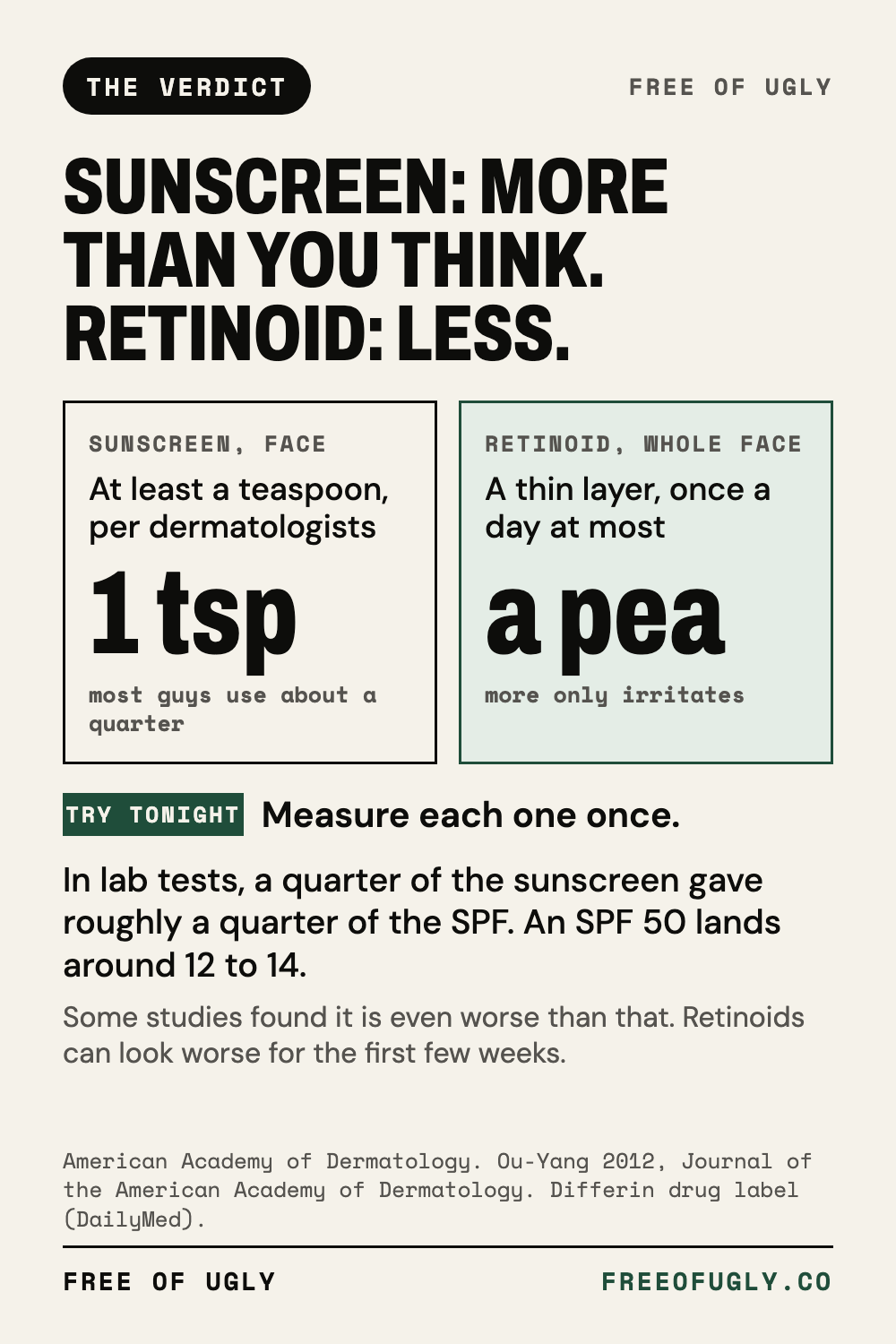
Sunscreen: the amount most guys skip
The American Academy of Dermatology, the professional body for US dermatologists, says to use at least 1 teaspoon of sunscreen on your face, about the length of your index and middle fingers, and to reapply every two hours outdoors.
SPF is the sun protection number on the bottle. It is measured in the lab at 2 milligrams of sunscreen per square centimeter of skin. Studies of how people really apply it find about a quarter of that. A 2007 Danish study of SPF and sunscreen amount (Faurschou and Wulf) reports that people apply roughly a quarter of the tested amount.
What a quarter of the amount does: in one study funded by Neutrogena (Ou-Yang and colleagues, 2012), products labeled SPF 70 and SPF 100 measured SPF 19 and SPF 27 when applied at a quarter of the tested amount. That is about 27 percent of the label number both times. Apply the same ratio to an SPF 50 and you get roughly 12 to 14. In plain words: in those lab tests, a quarter of the sunscreen gave roughly a quarter of the SPF.
Try this tonight: squeeze 1 teaspoon of your sunscreen into a measuring spoon once. Look at how much that is. Then put it on your face, neck and ears. Most people are surprised by the amount.
One wording note. "A teaspoon" is the dermatologists' guidance. The lab test amount works out smaller: about a quarter teaspoon for the face alone and about half a teaspoon for face and neck together. Either way, it is far more than most people use.
Retinoid: the amount most guys overdo
A retinoid is a vitamin A skin treatment. The one sold over the counter for acne is adapalene (Differin). Its drug label says to cover the entire affected area with a thin layer, use it once a day, and not more than once a day. It also says: "Applying more than directed will not provide faster or better results, but may worsen skin irritation."
That means the whole area, not single pimples. A pea-sized amount is the usual rule of thumb for spreading over a whole face. The label itself says "a thin layer", not a size.
Expect a rough start. The label says your acne may appear to worsen before it improves, and calls that normal. Do not judge it in the first couple of weeks.
Try this tonight: a pea-sized amount, spread thin over your whole face, once. If your skin gets dry or red, use it less often, not more.
What this does not tell you
- The "quarter of the amount" figure is an average from studies of how people apply sunscreen. Your own amount may be higher or lower. We could not open the full text of the 2007 study, only summaries of it.
- How fast protection falls as you use less is argued over. The 2012 study above found a drop that is close to straight-line. The 2007 study found the drop is exponential, which would be worse. A 2012 Chinese study (Liu and colleagues) found a straight-line drop for low SPF products and an exponential one for SPF 30 and 55. Other reviewers say half the amount gives about a third to a half of the label SPF, which is milder than straight-line. So "roughly 12 to 14" is the straight-line estimate, not a promise.
- The 2012 study was paid for by Neutrogena, whose employees were among the authors. Its own conclusion was that very high SPF products make up for under-use better than SPF 30 or 50 do. These are lab results, not real days outdoors.
- We found no single study that measures the "teaspoon for the face" figure. It is the dermatologists' recommendation, and the lab dose works out smaller. We did not find a study of which one gets better protection in real life.
- The drug label does not use the word "pea." Pea-sized is common dermatologist advice, but we could not find it on a dermatologists' association page, so treat it as a rule of thumb. If you use a prescription retinoid, follow your doctor.
- Sunscreen math is about SPF only. We did not compare brands, ingredients or UVA protection.
The math
| Label SPF | Tested amount | At about a quarter of that amount | Source |
|---|---|---|---|
| SPF 100 | 2 mg per square cm | SPF 27 measured | Ou-Yang 2012 |
| SPF 70 | 2 mg per square cm | SPF 19 measured | Ou-Yang 2012 |
| SPF 50 | 2 mg per square cm | About 12 to 14 (our straight-line estimate) | 19/70 and 27/100 are both about 0.27; 50 x 0.25 = 12.5, 50 x 0.27 = 13.5 |
The SPF 50 row is not a measurement. It applies the same ratio the study found for SPF 70 and 100. Studies disagree on whether the real drop is gentler or steeper than this.
Sources
- American Academy of Dermatology: How to apply sunscreen"At least 1 teaspoon" for the face; reapply every two hours outdoors. Last updated 8/15/25. Accessed 2026-10-23.
- Ou-Yang et al. 2012, J Am Acad Dermatol 67(6):1220-7. High-SPF sunscreens (SPF 70 or higher) may provide ultraviolet protection above minimal recommended levelsSPF 70 and 100 measured SPF 19 and 27 at 0.5 mg per square cm. Funded by Neutrogena. The PubMed page asks for cookies; we confirmed the details from search summaries of the abstract. Accessed 2026-10-23.
- Faurschou and Wulf 2007, Br J Dermatol 156(4):716-9. The relation between sun protection factor and amount of sunscreen applied in vivoAuthors conclude the relation is exponential. Summarized in The Pharmacist (thepharmacist.co.uk/?p=1314), which also reports people apply about a quarter of the tested amount. We read the summary, not the paper. Accessed 2026-10-23.
- Liu et al. 2012, Photodermatol Photoimmunol Photomed 28(3):120-6. Sunburn protection as a function of sunscreen application thickness differs between high and low SPFsLinear for SPF 4 and 15, exponential for SPF 30 and 55. The PubMed page asks for cookies; details are from the abstract as shown in search results. Accessed 2026-10-23.
- Lab Muffin Beauty Science: SPF changes how much sunscreen to useA chemist's review. Gives about 1/4 teaspoon for the face alone and 1/2 teaspoon for face and neck at the lab dose, and says half the amount gives about 1/3 to 1/2 of the label SPF. A blog, not a study. Accessed 2026-10-23.
- DailyMed: Differin (adapalene) gel 0.1%, Galderma Laboratories, drug label"Cover the entire affected area with a thin layer." Once daily, not more. "Applying more than directed will not provide faster or better results, but may worsen skin irritation." Acne "may appear to worsen before it improves (this is normal)." Accessed 2026-10-23.
- American Academy of Dermatology: 5 common sunscreen mistakes, and how to avoid them"Most people only apply 25-50% of the recommended amount of sunscreen." About 1 ounce, roughly a shot glass, for skin not covered by clothing; apply 15 minutes before going outdoors; reapply every two hours outdoors or after swimming or sweating. Updated 8/15/25. Accessed 2026-11-20.
- American Academy of Dermatology: Sunscreen FAQsSunscreens "form a protective layer on your skin that absorbs the sun's rays"; people apply about 20-50% of the amount "needed to achieve the amount of SPF on the label". Updated 2/11/25. Accessed 2026-11-20.
- Petersen and Wulf 2014, Photodermatol Photoimmunol Photomed. Application of sunscreen: theory and realityA review: people apply about 0.39 to 1.0 mg per square cm, against the 2 mg used in testing, which "decreases the protection factor considerably." From the abstract. Accessed 2026-11-20.
Prices checked 2026-10-23. Prices move.
Some links earn us a commission. We link the winner either way.
Information, not medical advice. If something here applies to you, ask a doctor or dermatologist.
Free of Ugly: science over grift. If it works we say why. If it does not we say that too.